This article describes the visual quality control system Specto commissioned for a manufacturer in the chemical industry. The company name and product details are not shared for confidentiality reasons.
Product and line
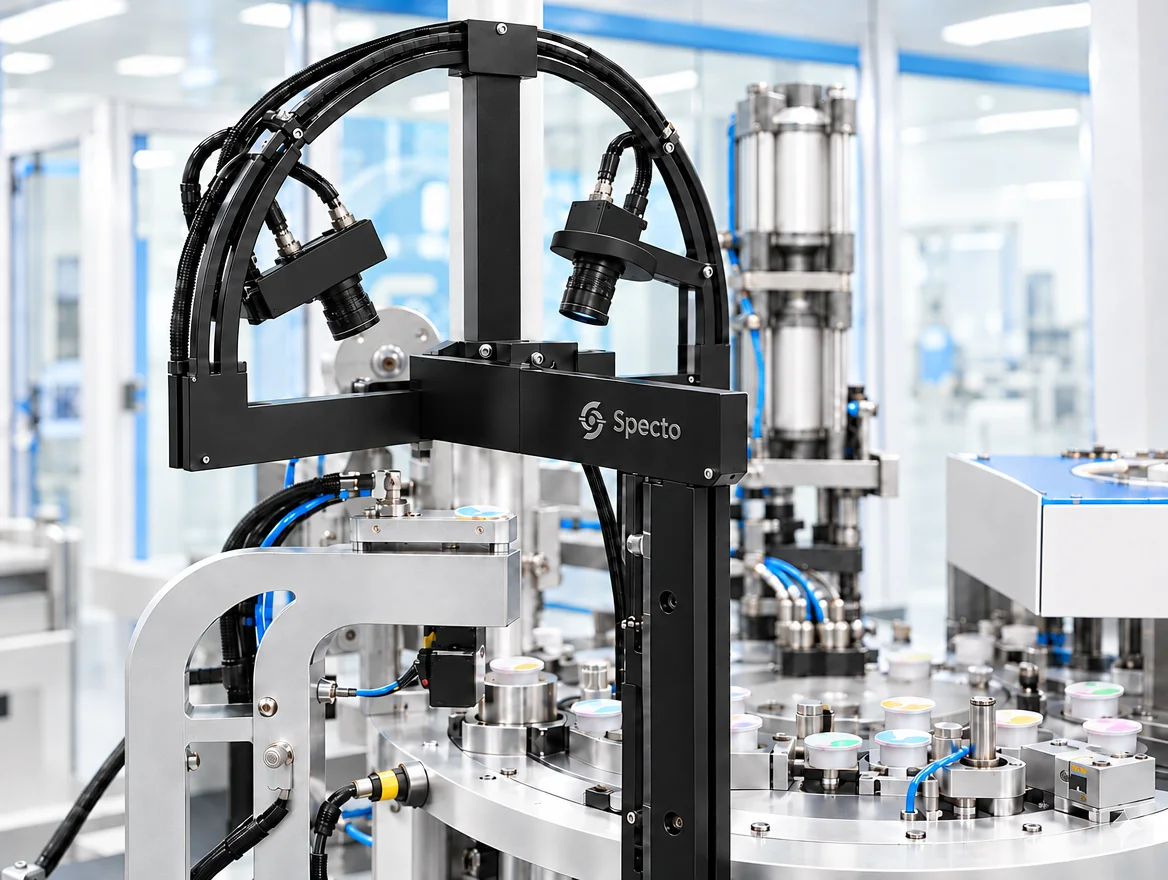
The inspected product is a capsule consisting of a plastic body, a printed paper lid on top and a plastic rim. The capsules move on a rotary indexing table, and two capsules pass under the camera station at the same time.
Inspected defects
- Print running over the paper edge, or a cut or distorted print edge
- Lid not fully seated on the body, and skewed seating
- Bulging of the paper lid
- Crushed rim
- Dark stains on the surface
The system
Two industrial area-scan cameras and strobe lighting were installed at the station. The sensor that detects the arriving part, the strobe and the rejector that removes defective products were connected to a control board developed by Specto. When a capsule reaches the sensor, the strobe fires and the image is captured at that moment, so every image is taken under the same lighting conditions.
The cameras are at one station of the table and the rejector is at the next. The decision is made before the capsule reaches the rejector, and a defective capsule is rejected when it arrives in front of the rejector.
How is the decision made?
The system derives the product’s reference profile from images of good capsules. Every capsule is compared with this reference; a capsule that exceeds the allowed deviation is marked NOK and the reject reason is recorded.
This approach has two practical benefits on the shop floor:
- There is no need to collect samples of every defect type for setup; the system is set up with good products, and defective samples are used to validate the results.
- The only decision parameter adjusted on site is the allowed deviation, which keeps the system simple to use.
Fail-safe
If a decision cannot be made in time, the camera connection drops or a capsule cannot be recognized, the product is not accepted as good and is rejected. An empty slot is also counted as NOK. This way, a problem in the system never creates a risk of a defective product being shipped.
Screens and records
The system runs on the company’s own computer without an internet connection and was installed as a desktop application that opens with the company’s logo. The operator screen shows the live OK/NOK result, counters and the latest rejects. The image and reject reason of every decision are recorded; records can be filtered and exported.
In this project, the camera, lighting, control board, software and commissioning were all handled by the same team. If you have a similar inspection need, we can carry out a preliminary assessment with product images or samples.