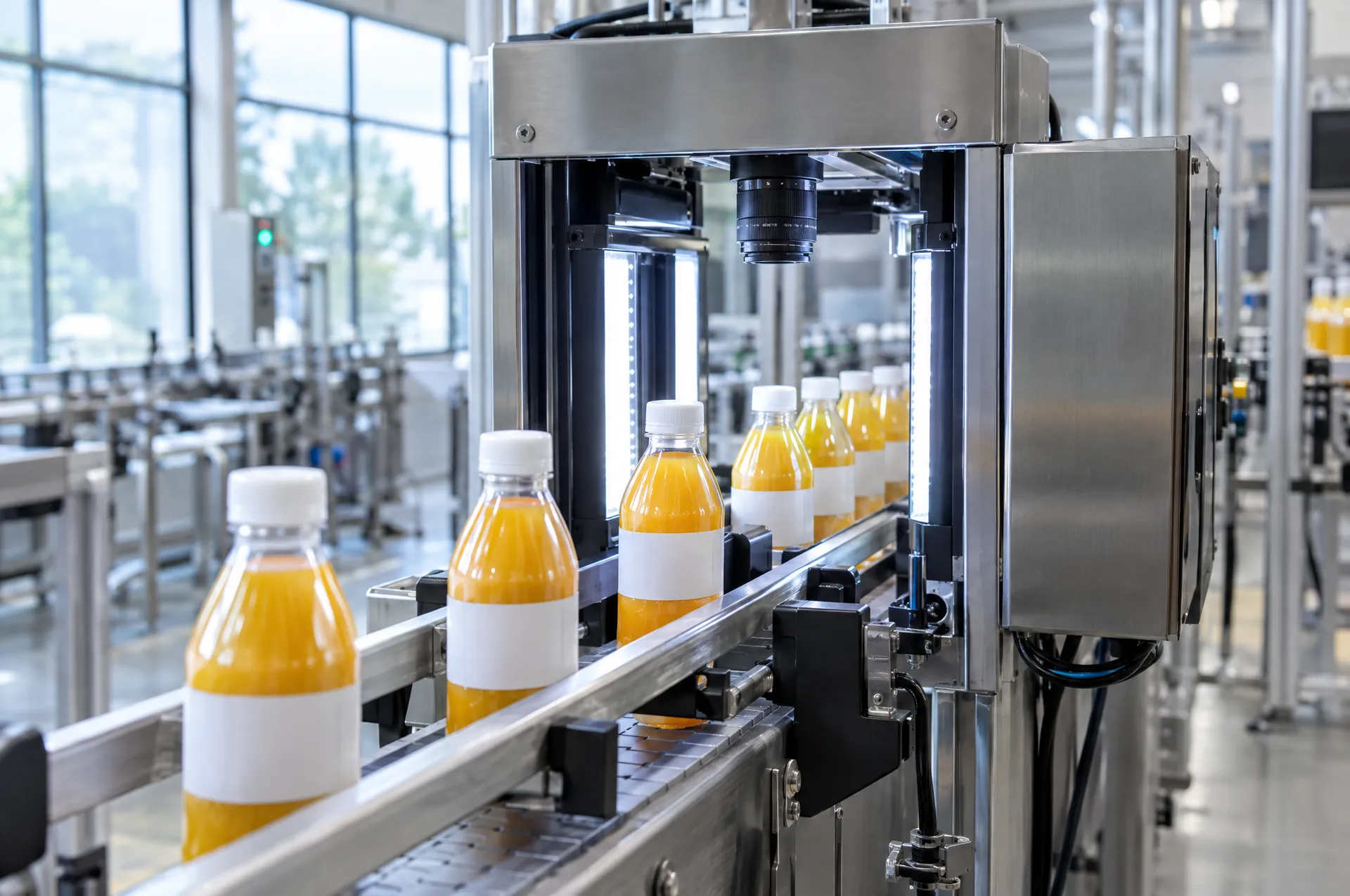
Label and date code errors lead to recalls, customer complaints and audit issues even when the product itself is fine. On food, pharmaceutical, chemical and cosmetics lines, checking every single product is increasingly a requirement. Camera-based label inspection does this at line speed, with the same criteria for every product.
What is checked on the label?
- Presence: Prevents unlabelled products from leaving the line.
- Position and skew: Shifted, skewed or folded labels are detected.
- Correct label: Use of the wrong label after a product change is verified visually or by barcode.
- Print quality: Faded, incomplete or smudged prints are rejected.
- Damage: Tears, bubbles and wrinkles are checked.
Date code and batch number
The expiry date and batch number are the most critical information on the package. With a camera and character reading software, every product is checked for:
- whether the print is present,
- whether the characters are legible,
- whether the printed information matches the day's date and batch.
Products with a wrong or unreadable code are rejected automatically.
Combined with cap and fill checks
The same inspection station can often also check cap presence, correct seating and fill level. This way the whole package is verified at a single point at the end of the line.
Records and traceability
The image and inspection result of every product are recorded. In the event of a complaint or audit, the inspection records of the batch concerned can be reviewed. In sectors where traceability matters, such as pharmaceuticals and food, these records are especially valuable.
Points to consider during installation
- For glossy label materials, lighting that prevents reflections should be chosen.
- On cylindrical products, several cameras or a rotating fixture may be needed to see the whole label.
- On high-speed lines, trigger and reject timing is planned separately.
We describe the components and steps of the system on the label and code inspection system page. See how we set up a similar application in our capsule line case study. You can also request a preliminary assessment for your own line.