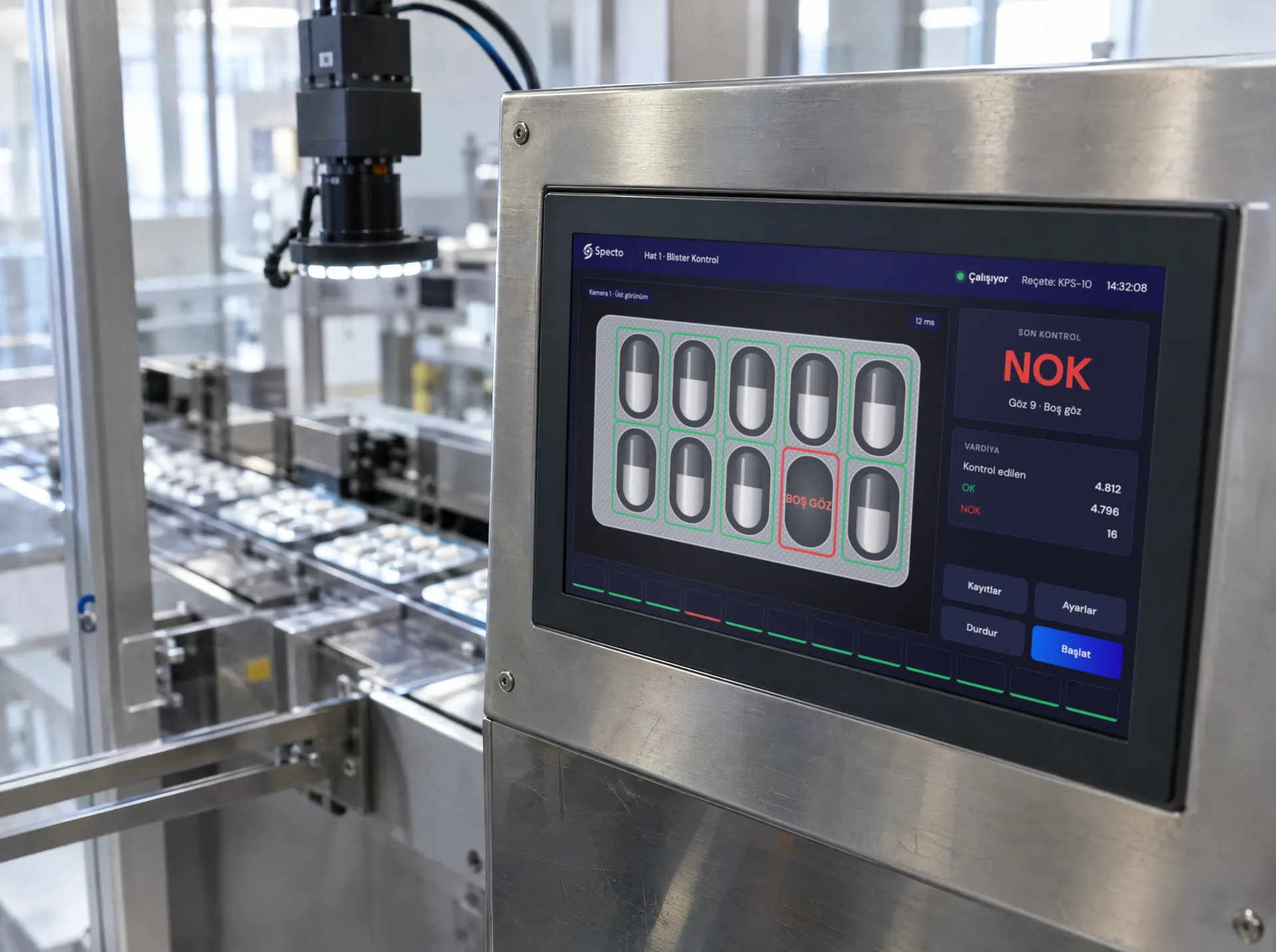
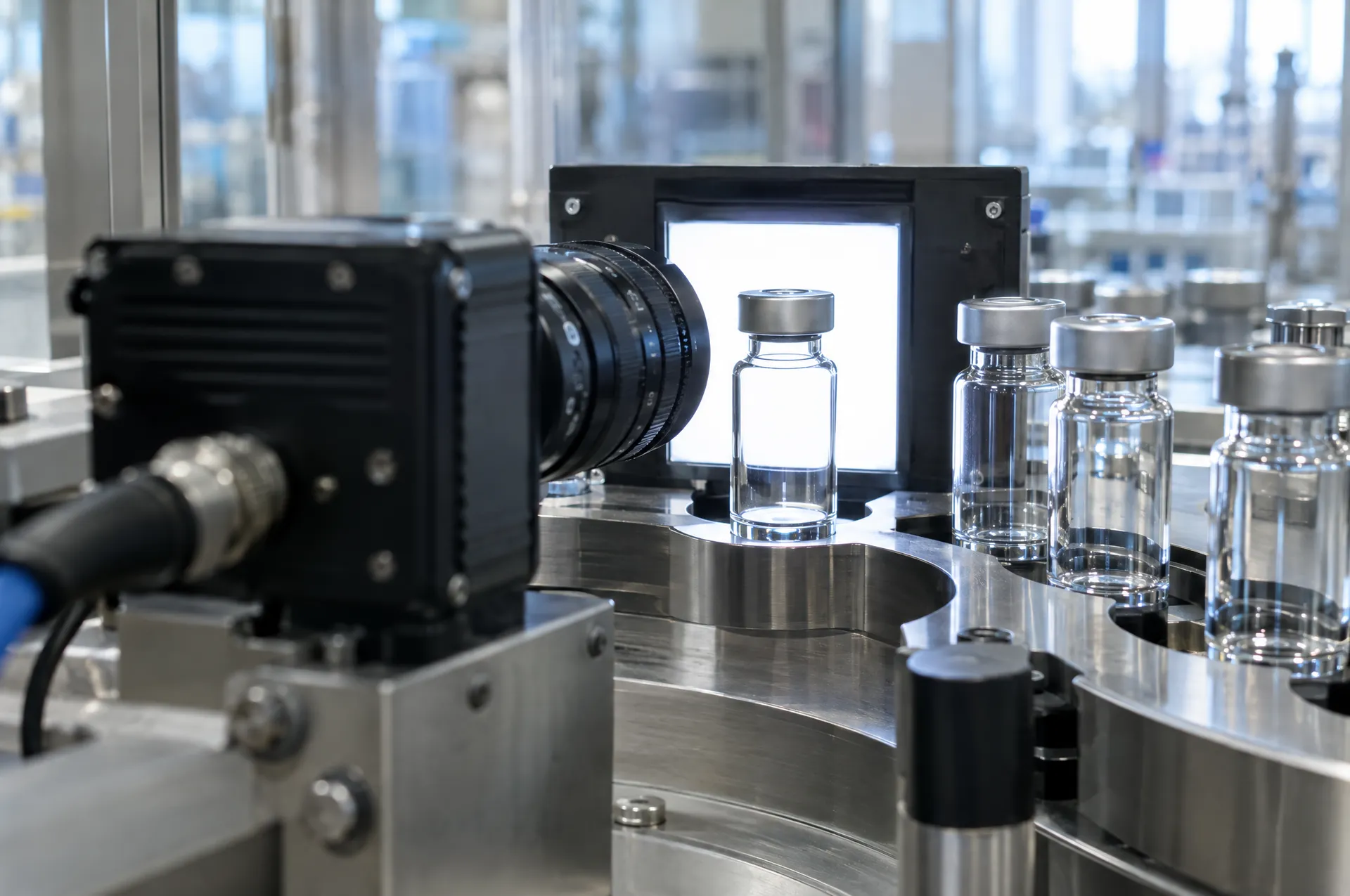
Cap and seal inspection means checking on the line, after filling, that the container's cap is present, correct and properly seated, and that tamper-evident features such as the tamper band or seal are intact. The camera checks every externally visible feature of the cap on every product against the same criteria and removes defective products. Whether the foil under the cap has bonded, or whether the container is leak-tight, are questions the camera cannot see. In this post we explain which checks should be done with a camera and which with another method.
What is checked on caps and seals?
| Defect | What is checked | Suitable method |
|---|---|---|
| Missing cap | No cap on the container mouth | Camera; a sensor in simple applications |
| High cap | Cap not fully down on the neck | Side-view camera |
| Skewed cap | Cap seated at a tilt to the container axis | Cameras viewing from different angles |
| Wrong cap | Colour, type or print different from the expected cap | Top-view colour camera |
| Cap damage | Dented, cracked or broken cap | Camera |
| Tamper band defect | Broken bridges, missing band or band left too high | Cameras that see around the container |
| Neck band | Missing or offset band around the cap and neck | Camera |
| Induction foil presence | Foil present under the cap | Camera before capping; metal-detecting sensor after capping |
| Foil bonding and leak tightness | Foil fully bonded to the mouth, no leaks | Leak testing; a camera alone cannot verify it |
| Cap torque | Cap closed to the correct tightness | Torque measurement |
How does the camera see the cap?
The most common setup for cap inspection is a side-view camera. A backlight placed behind the container shows the cap and neck as a sharp silhouette. The software measures the top edge of the cap relative to a fixed reference on the container, usually the neck ring or shoulder. A cap that sits too high relative to the reference is a high cap; different heights on either side of the cap mean a skewed cap.
A tilt can be in any direction. A single camera looking from one side can miss a tilt along its own line of sight. That is why skewed caps are usually checked with two cameras at right angles to each other, or with several cameras that see around the container.
A camera looking from above checks cap presence, colour, print and damage. On vials, the aluminium crimp cap and the plastic flip-off cap on top are also checked from above and from the side; deformation of the crimp skirt is visible from the side. On shiny aluminium, dome or diffuse lighting is needed to suppress reflections. See machine vision lighting for details.
On lines with frequent product changeovers, the wrong cap is also a significant risk. If caps of different colours or prints are fitted to the same container for different products, a separate product profile is defined for each product. The profile is selected according to the production order, and the camera checks the colour and print of the cap against that profile. This way, caps left over from the previous run being fitted to the new product are noticed.
When a cap does not seat fully, the spilled product also shows up as underfilling at a later point. That is why, on most lines, cap inspection is done at the same station as fill level; we cover this in fill level inspection.
Tamper bands and tamper-evident features
A tamper band is a ring whose bridges break when the cap is first opened, showing that it has been opened. The bridges can also break during capping, or the band may not go down below the neck ring. Because these defects can appear anywhere around the band, several cameras that see around the container, or a mirror arrangement, are needed. Whether the bridges can be distinguished in the image depends on the design and colour of the cap; this is seen in tests with samples.
These features also appear in legislation. In the US, 21 CFR 211.132, which covers tamper-evident packaging for over-the-counter drug products, defines such a package as one with indicators or barriers to entry which, if breached or missing, provide visible evidence to consumers that tampering has occurred. The same section requires the tamper-evident feature to be designed to remain intact when handled in a reasonable manner during manufacture, distribution and retail display. In the EU, Delegated Regulation 2016/161 on medicinal products for human use defines the safety feature that allows verification of whether the packaging has been tampered with, and requires the integrity of this feature to be verified.
The camera checks the presence and visible integrity of these features on every product on the production line. The design, material and strength of the feature are matters for the packaging development stage.
Can induction foil be inspected with a camera?
An induction seal is formed when the aluminium layer inside the cap is heated by an electromagnetic field after capping and bonds to the container mouth. Once the cap is fitted, the foil is hidden from the camera. So the honest answer is this: a camera cannot see the foil inside a closed container.
In practice, inspection is divided as follows:
- Before capping: If caps travel upside down along the feed line, a camera looking from above can check whether each cap contains the foil layer and whether it is seated correctly. If the foil is placed on the container mouth separately, the camera also sees it before capping.
- After capping: The presence of the metal foil inside the cap is checked through the plastic cap with inductive sensors that detect metal. These sensors show only the presence of the foil, not the quality of the bond.
- Bonding and leak tightness: Whether the foil has bonded across the whole mouth and whether the container is leak-tight are verified with leak tests. The settings of the sealing machine and these tests are planned according to the site's own quality procedure.
For conditions inside opaque packaging, X-ray can also be considered; for example, fill level in an opaque container and foreign matter. The methods are compared in manual vs camera-based vs X-ray inspection.
How are defective containers rejected?
In cap inspection, rejection also prevents the defect from damaging downstream machines. A container with a high or skewed cap can cause a jam in the labelling or cartoning machine.
- Tracking: The distance between the camera and the rejector is tracked by conveyor speed or encoder signal; the reject signal is given when the container reaches the rejector.
- Fail-safe: If no image is captured or no decision is made in time, the container is not accepted as good and is removed.
- Consecutive defects: Repeated skewed or high caps on containers from the same capping head point to a setting problem on that head. If head information can be taken from the machine, results are tracked per head.
- Verifying rejection: At the start of a shift, test containers with missing caps, skewed caps and broken tamper bands are run through the line; both detection and rejection are checked.
What should be prepared before installation?
- Containers and caps: container shape, cap type, colours and tamper band design
- Seal: whether induction foil, a neck band or another tamper-evident feature is used
- Line: speed, distance between the capper and the inspection point, existing rejector and PLC
- Existing checks: methods the camera will complement, such as torque measurement, leak testing and weighing
- Samples: good containers, plus examples with missing, high, skewed and wrong caps and broken tamper bands
We describe how we inspect incomplete and skewed lid seating on a capsule line with two cameras in our capsule line case study. Other checks on packaging lines are on the assembly and packaging inspection page, and our approach to pharmaceutical and chemical lines is on the pharma and chemicals industry page. Contact us to assess how cap and seal inspection can be set up on your line.