
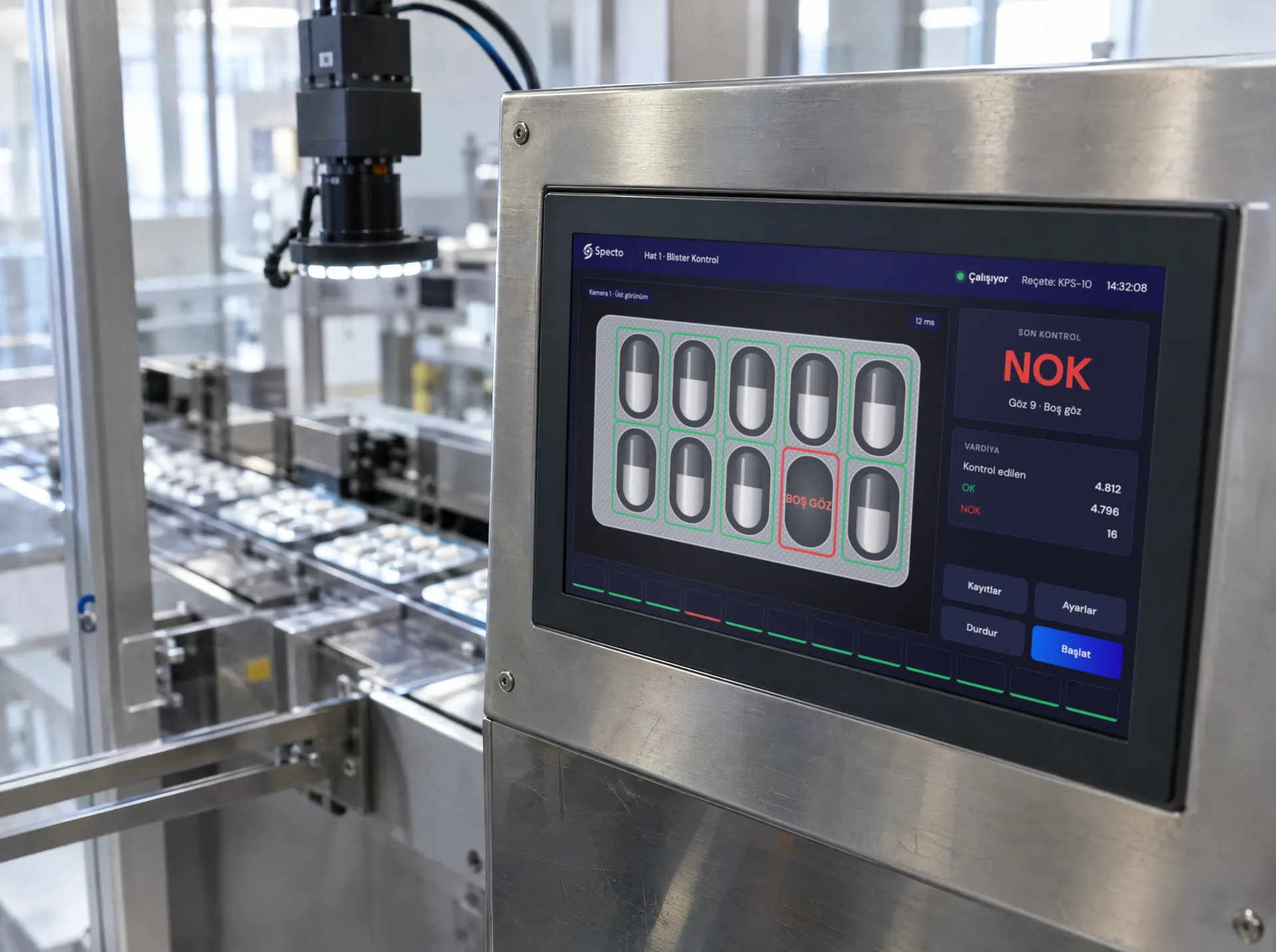
A blister inspection system images every pocket on a blister packaging machine with a camera, checks whether each pocket holds the correct product, complete and intact, and removes defective blisters from the line. Every blister and every pocket is checked against the same criteria, and the image and reject reason of every decision are recorded. For pharmaceutical and food supplement producers, the goal is to keep blisters with missing, broken or wrong products out of the carton.
We gave an overview of inspection points on packaging lines in visual inspection in pharmaceutical and chemical packaging. This post focuses on the blister line only.
What does a blister inspection system check?
The defects fall into two groups: those related to the product in the pocket, and those related to the lidding foil and sealing.
| Defect | What is checked | Inspection point |
|---|---|---|
| Empty pocket | No product in the pocket | Before sealing; also after sealing with clear film |
| Broken, cracked or chipped tablet | Missing edge, broken-off piece, crack | Before sealing |
| Open or crushed capsule | Separated capsule halves, crushing, deformation | Before sealing |
| Wrong product | Colour, shape or size different from the expected product | Before sealing |
| Foreign product | Product left over from a previous run or mixed in from another line | Before sealing |
| Double product | More than one tablet or capsule in a pocket | Before sealing |
| Debris on the sealing area | Dust or tablet fragments on the flat area between pockets | Before sealing |
| Foil damage | Tears, holes, wrinkles, misaligned foil | After sealing |
| Seal pattern | Missing or offset pattern | After sealing, where the pattern is visible |
| Foil print and embossing | Missing, faded or offset print; embossed batch number and expiry date | After sealing |
It is also important to know the limits of a camera image. A seal pattern that looks correct is not proof that the blister is leak-tight; leak tightness is verified with separate tests. The camera catches visible defects on every blister; it does not replace leak testing.
Where does the camera sit on a blister packaging line?
A blister machine has two main inspection points: after the product is fed into the pockets, and after the lidding foil is sealed.
Before sealing: The product sits in open pockets and is seen directly from above. Empty pockets, broken tablets, wrong and foreign products, double products and debris on the sealing area are checked here. Most product-related checks are done at this point.
After sealing: A camera looking at the foil side checks foil damage, the seal pattern, and the print and embossing on the foil. On blisters formed from clear PVC or PVDC film, the product is also visible from below, so a product crushed or displaced during sealing can be checked a second time.
The choice of material directly shapes the inspection plan. On cold-formed aluminium blisters (alu-alu), both sides are opaque; once the foil is sealed, the product cannot be seen from any angle. On these lines, every product-related check has to happen before the sealing station.
An inspection point can also be added after the blisters are cut and before cartoning. Here the cutting position and the number of blisters are checked.
How are lighting and cameras chosen?
The difficulty with blisters is usually low contrast: a white tablet sits in white or clear film, while aluminium pockets and foil are shiny. That is why lighting is considered before the camera.
- Backlight with clear film: Light comes from beneath the blister, and an opaque tablet appears as a sharp silhouette. Empty pockets, broken edges and double products become distinct.
- Dome or diffuse lighting: Suppresses reflections in alu-alu pockets and on shiny foil, while chips and stains on the surface remain visible.
- Low-angle lighting: Highlights small chips on tablet edges and embossed markings.
- Colour camera or coloured light: Used to distinguish wrong-colour products and the colour order of two-tone capsules.
- 3D imaging: Can be considered where the problem shows up as a height difference, such as overlapping tablets.
On the camera side, the deciding factors are the smallest chip that must be detected and the width of the inspected area. If the blister web is wide or the required detail is small, several cameras are used across the web. The machine may run in intermittent or continuous motion; the image is triggered by the machine cycle or encoder signal and captured with a strobe, so every image is taken under the same lighting conditions. See machine vision lighting and industrial camera and lens selection for details.
The right setup is determined not at a desk but through tests with good and defective samples. How clearly empty pockets, broken tablets and foreign products stand out in the image is seen before installation.
How are defective blisters rejected?
The camera decides per pocket, while rejection happens per blister. Between the pre-sealing camera and the reject point are the sealing and cutting stations. The system tracks which blister a defective pocket will end up in according to the machine's indexing, and sends the reject signal when that blister is cut. Rejection is done by the machine's own reject station or by a rejector added to the line.
Points to watch in practice:
- Fail-safe side: If no image is captured, the decision is not made in time or the product cannot be recognised, the blister is not treated as good and is rejected.
- Stops and restarts: When the machine stops and restarts, the position of tracked blisters must be kept, and blisters whose status is uncertain are rejected.
- Repeated defects: Empty pockets or broken tablets repeating in the same pocket point to a problem on the feeding or filling side. The system can alert the operator or stop the machine via the PLC.
- Verifying rejection: At the start of each shift and after a format change, known defective test blisters are run through the line, checking both that the camera finds the defect and that the rejector removes that blister.
Is this the same as checking batch number and expiry on the carton?
No. Blister inspection checks the product in the pocket and the blister itself. The batch number, expiry date and 2D code on the carton are checked by a separate camera at or after the cartoner, using optical character recognition (OCR) and verification (OCV). Batch and date information embossed or printed on the blister foil can be read at the post-sealing station.
We cover carton-side inspection in camera-based label and date code inspection and on the label and code inspection system page.
How should records be kept from a GMP perspective?
The EU Guidelines for Good Manufacturing Practice (GMP) and the Turkish Medicines and Medical Devices Agency's (TİTCK) GMP guide for human medicinal product manufacturing sites (version 2024/04) cover packaging operations in their production chapter under the same clause numbers. According to clause 5.59, on-line control of the product during packaging should include at least checking the general appearance of the packages, whether the packages are complete, whether the correct products and packaging materials are used, whether any over-printing is correct, and the correct functioning of line monitors. Clause 5.57 asks for checks to ensure that electronic code readers, label counters and similar devices are operating correctly. Running test blisters at the start of a shift is the practical answer to this.
When inspection is done by software, the annexes of the same guidelines on computerised systems (Annex 11) also apply: data should be protected against damage and remain accessible throughout the retention period, GMP-relevant changes and deletions should be recorded with their reason (audit trail), and changes to system configuration should be made in a controlled manner.
Questions to ask when evaluating a blister inspection system:
- Are the image, time, reject reason and batch of every decision recorded?
- Can records be filtered by batch and exported?
- Who can change the product profile and acceptance limits, and how is the change recorded?
- Do images and records stay on site, and how are they backed up?
Qualification and validation of the system are planned within the site's own quality system. Sites producing food supplements can use the same record structure for their own quality system and customer audits.
What should be prepared before installation?
- Blister formats: number of pockets, pocket layout and web width
- Products: tablet and capsule types, colours, distinguishing features such as print or score lines
- Material: clear film, coloured film or alu-alu
- Machine: intermittent or continuous motion, distance between the sealing and cutting stations, existing reject station and PLC
- Samples: good blisters, plus examples with empty pockets, broken tablets, foreign products and foil defects
On lines with frequent format changes, a separate product profile is defined for each format and the relevant profile is selected for production.
We describe how the sensor, strobe, control board and rejector work together, along with the fail-safe approach, in our capsule line case study. Our approach to pharmaceutical and chemical lines is on the pharma and chemicals industry page. Contact us to assess together which checks can be done at which point on your blister line.